

Introduction
What Is a Trial Stay in Assisted Living?
Why a Tour Is Not Enough
Reasons Why a Trial Stay in Assisted Living Helps Families Make Better Decisions
When Should You Consider a Trial Stay?
How to Talk to Your Parent About a Trial Stay
Questions to Ask Before Booking a Short Stay Before Permanent Care
How Long Should an Assisted Living Trial Period Last?
What to Observe During the Stay: A Family Checklist
What Should Families Evaluate When Testing a Senior Home?
Why Consider Sahabhaav for a Short Stay Before Permanent Assisted Living?
Final Word
Frequently Asked Questions
Key Takeaways
|
What if you could know whether an assisted living facility is right for your parents or not before making a permanent decision. Would not that make the entire process a little easier?
Moving into senior care is not only a decision about finding a comfortable room or arranging daily assistance. You need a safe space where your parents can build trust with caregivers and become familiar with a new routine.
Whether you call it testing a senior home or an assisted living trial period, the idea is simple: experience the environment before deciding to stay. Let us look at what families should consider before making that decision in this blog.
A trial stay in assisted living is a temporary residential arrangement that allows seniors to experience a care facility before committing to a permanent move. It gives families time to evaluate the living environment, caregiving services, daily routines and overall comfort while helping seniors decide whether the new setting suits their needs.
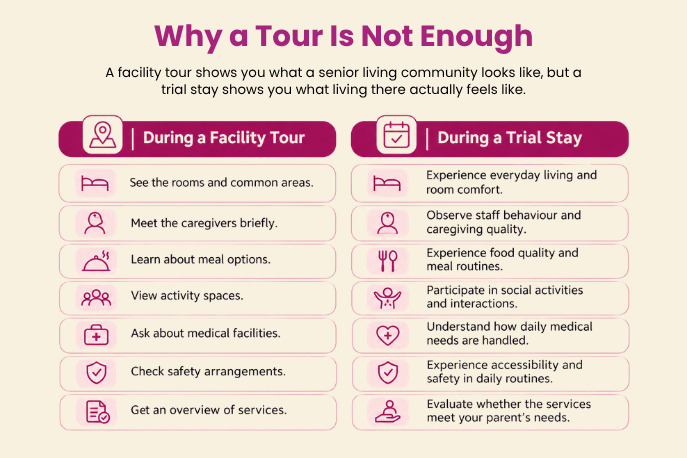
A facility tour shows you what a senior living community looks like, but a trial stay shows you what living there actually feels like.
| During a Facility Tour | During a Trial Stay |
| See the rooms and common areas. | Experience everyday living and room comfort. |
| Meet the caregivers briefly. | Observe staff behaviour and caregiving quality. |
| Learn about meal options. | Experience food quality and meal routines. |
| View activity spaces. | Participate in social activities and interactions. |
| Ask about medical facilities. | Understand how daily medical needs are handled |
| Check safety arrangements | Experience accessibility and safety in daily routines. |
| Get an overview of services. | Evaluate whether the services meet your parent’s needs |
The key difference: A tour gives you a first impression while a trial stay gives your family a real-life experience.
| According to NITI Aayog, about 75% of older Indians live with at least one chronic condition and about 24% have difficulty with at least one daily activity. |
| 1, | The older parent is hesitant about moving into assisted living permanently. |
| 2, | The family wants to evaluate a senior home’s care quality before committing. |
| 3, | Your parent needs temporary support after hospitalization or illness. |
| 4, | You are unsure whether the facility can meet your parent’s daily care needs. |
| 5, | Parents feel lonely or need more social interaction with companionship. |
| 6, | You want to understand the staff’s responsiveness & medical support. |
| 7, | When your family is comparing multiple assisted living facilities. |
| 8, | They need time to adjust to a new environment before making any decision |
| 9, | When you want your parent to experience assisted living. |
Start the conversation with empathy rather than making them feel that a decision has already been made for them. Explain that a trial stay in assisted living is an opportunity to experience a new environment, meet caregivers and explore daily routines without committing to a permanent one. Listen to their concerns plus involve them in choosing the facility, which can reassure them that their comfort and preferences are final.
Instead of saying, “We think you should move into an assisted living facility,” try saying, “Why don’t we visit a senior living home and try to stay there for a few days?” You can experience the food, meet new people and see how comfortable you feel. If you don’t like it, we can discuss other options together.
| The Government of India provides the e-Sanjeevani platform that offers free telemedicine including counselling for loneliness and stress. |
Before booking permanent care, families should understand what the facilities offer and whether they can meet their parents’ needs. Asking the right questions can avoid confusion. Some of the questions are as follows:
The ideal assisted living trial period depends on your parent’s comfort, care requirements and how much time they need to adjust to a new environment. A few days offer an initial experience, while a stay of one to two weeks or longer helps families understand daily routines, caregiving quality, social interaction and overall comfort.
A senior home looks appealing during a visit but the real experience depends on the little things that shape everyday living. When testing a senior home, families should look beyond the facilities and pay attention to how well the environment supports their parent’s comfort, independence and care needs. You can look at things like
Choosing a senior living community becomes easier when families can experience the care and facilities before making a long-term decision. Sahabhaav offers short-stay residential care in Mumbai, where seniors can stay for a few weeks to several months. During this period, they get access to caregivers, nurses, daily doctor visits and group activities.
We served 300+ seniors over 7 years, handled 100+ medical emergencies and conducted 40+ outings within Mumbai. Seniors get personalized care plans, nutritious meals, social engagement activities and emergency medical assistance. We also provide wheelchair-accessible bathrooms, round-the-clock nursing support and single or twin-sharing rooms.
Testimonials A well done up and Happy place. Dr Mini with the support of her staff and ever smiling Amee, takes keen interest in ensuring that Sahabhaav delivers what it promises – a place where care and well being of elders in the family is of utmost importance. We are at peace that Sahabhaav is an extension of our home and even when we are away – everything that we would do for our elders is being taken care of by the efficient team. Best wishes. — Prerna Varma My wife was staying at Sahabhaav for 3 weeks and when I visited her I was impressed with the cheerful atmosphere and the activities that the residents were engaging in like Yoga and craft. There is a sense of teamwork between the many nurses, doctors and attendants who support the residents and are always at hand for all needs. My gratitude to Dr. Mini and her capable and empathetic staff. — ashley nazareth |
Choosing assisted living for an older parent is a decision that deserves time, patience and careful consideration. A trial stay allows families to experience the care environment before making a permanent commitment. Instead of relying only on visits and conversations, you can make a decision based on real experiences. It is best to involve your parent at every step and give their comfort and preferences priority.
Connect with Sahabhaav and let your parent experience a little of what feeling at home in a senior living community can be like!
Yes, depending on the facility’s services, a trial stay includes nursing assistance, medication management, doctor visits and emergency support. Always confirm the services included before booking.
Families should discuss their parent’s concerns with the facility and explore alternatives. If the senior remains uncomfortable, they can reconsider the arrangement rather than rush into a permanent stay.
A short stay refers to temporary accommodation whereas respite care provides temporary relief for family caregivers. A trial stay specifically helps families assess a facility before long-term admission.
<!–FAQPage Code Generated by https://saijogeorge.com/json-ld-schema-generator/faq/–