
Think about it, settling somewhere that you think of as a paradise of care, security, and friendship—but you end up discovering that your views, privacy, and choices are completely ignored. This is why residents rights elder care India matter. Indian senior citizens truly have the right to be in an environment that is conducive to their being treated with respect, being safe, and enjoying lively independence.
In this blog, we shall look into what seniors need to be aware of, the legal protections that are provided, the common hurdles, senior citizens rights India, and the practical methods to get their rights respected.
The rights of residents are the primary legal and human rights of elderly people residing in nursing homes or similar establishments. The rights in question will not only save the elderly from all sorts of abuse, but will also enable them to live a life full of comfort, dignity, and more importantly, with independence. In India, the rights of residents in elder care homes are determined by:
In other words, residents’ rights simply mean that every senior living in a care home has the right to be treated with love, care, and respect.
Aging persons who are placed in a nursing home will still retain their rights. Here are some rights, partly legal, partly moral with examples:
At the beginning, the communication with the elderly residents should be polite and courteous and they should be given personal considerations (e.g. time for meals, room arrangement).
Furthermore, they are entitled to privacy in their living quarters which are to be kept as quiet and unobtrusive as possible; they are to be allowed not to be monitored at all when not medically required.
And last but not the least, no one in the institution should be subjected to enforced admission or relocation without consent except under very stringent conditions.
The care provider must provide its clients with the following: safe infrastructure, emergency response systems, hygienic and clean living areas, and no access to their physical or psychological mistreatment or exploitation.
The patient, who is being treated at the facility, should not suffer from any form of neglect, be under harassment, or experience any kind of physical or mental abuse.
They should have the possibility of living in a place where they feel safe and secure. Actually “The Right to Safe and Secure Living Arrangements” is one of the rights of the elderly.
Informed consent is one patient’s right that has the most weight in nursing homes. The patient rights in care homes are entitled to:
No medical procedure is going to be performed on the resident without their consent unless it is a life-threatening situation.
The senior citizens should have full control over their finances and possessions. Making them sign property deeds or putting limits on their money is considered a violation of the law under senior citizens’ rights, India elder care legal rights.
An elderly person who is isolated will soon have their mental health affected. Institutions must organize socialization through cultural and artistic celebrations, hobby clubs, and family visits.
Being part of a community gives happiness and emotional wellness, a social aspect that is very significant for the rights of elderly care in India.
The Indian law discussed here is possibly the best piece of legislation for elder rights in India. The main points of senior citizens rights India are as follows:
This law is the cornerstone of resident rights elder care in India discussion as it grants rights in the form of care, maintenance, and protection.
The legislation not only stipulates but also upholds the legal rights of the elders living in the facilities to receive proper care. It concentrates on:
The MWPSC Act also provides that abandonment of a senior citizen is a crime in some cases with punishment (imprisonment for three months or fine of Rs 5,000 at most) involved.
| The “What are the privacy rights of senior citizens in care facilities?” article explains that the older people living there have the right to autonomy and to be free from intrusive monitoring in the care home’s vicinity. Click Here and Read |
| The “What laws apply if a senior citizen is forcibly institutionalised?” The article highlights that consentless institutionalisation is a severe issue under the elder protection laws. Click Here and Read. |
Even though it is not completely a law of India, still international standards do have an impact on Indian policy. For instance, the UN Principles for Older Persons (1991) lay stress on the areas of independence, participation, care, self-fulfillment, and dignity. These areas would be helpful in our interpretation of the rights of senior citizens in broader terms along with the Indian elder care legal rights.
Let’s consider the law implications specifically in a senior care facility:
A senior citizen care home residence elderly person of 60 and above who is not receiving proper care from family could (again, assuming their dependent) submit a request for maintenance according to the Act.
An older person who transferred property to a child or relative with the stipulation that he or she should be taken care of can, if the relative ends up neglecting the senior, seek to have the property transfer declared void under Section 23.
If a senior in a facility or on the street is left there by someone with whom they have a care relationship, the criminal law could apply.
The Act also mandates the government to establish one old age home in each district for poor senior citizens.
The utility of the Act may not be in such drastic regulation of every private care home, but its principles certainly claim that the seniors have rights to maintenance, not to be left, and the sanctity of property.
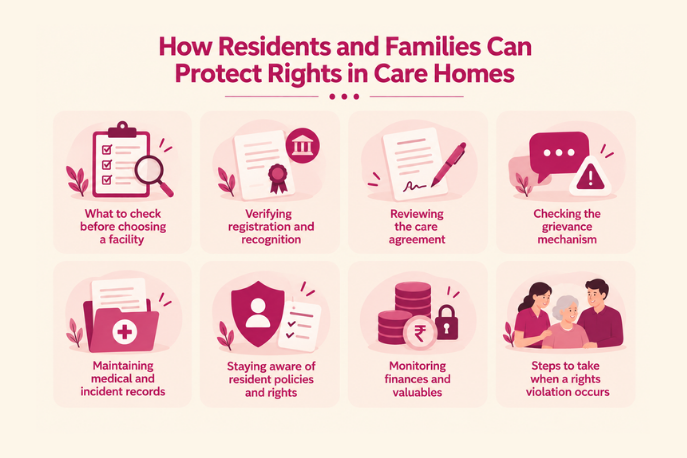
Here are some practical measures that can be taken by the residents, their families, and the employees of the care facility to protect the rights of older persons in India:
Go to the facility in person, converse with the residents who are there at the moment, inquire about the conditions under which the residents live, the activities that take place, and the number of staff assigned to the residents.
Verify if the facility is registered or recognized by the local authorities (if applicable).
Request a written contract indicating services that are included, the amount to be paid, the rules on movement in and out, visitors, medical care, and how one can exit or enter.
Ascertain that there is a grievance mechanism: who to contact if things do not go well.
Think about the place, the distance to hospitals, and the emergency services’ accessibility.
First of all, take note of the problem then make a written record of it, take photos if needed, and keep a log of your conversations.
Next, escalate the issue within the organization starting with management; talk to them and ask for a written reply.
Then, seek external support:
| Organization | Helpline / Contact | Support Provided |
| Elder Line | 14567 | National helpline for senior citizens |
| HelpAge India | 1800-180-1253 | Free legal, medical, and emotional support |
| National Human Rights Commission | www.nhrc.nic.in | For human rights violations |
| Police Senior Citizen Cell | Local police helpline | For safety and abuse issues |
| State Welfare Departments | Varies by state | Monitoring of care homes and old-age welfare |
Actually to strengthen residents rights elder care India, several steps will help:
We believe you must understand the residents rights elder care India through this blog, which ensures seniors live with dignity, respect, and independence. Are you searching for trusted senior care with all facilities? At Sahabhaav, we think of it as more than just providing elderly care in terms of facilities; it is compassion, trust, and developing a real feeling of home, we have all the things along with luxurious senior care. Click here and get more information instantly.
The government has launched four new schemes addressing healthcare, pension support, employment, and housing for senior citizens.
Yes, active participation in various forms of leisure helps to enhance one’s emotional state and also keeps the person socially connected, which is something that the standards of elder care in India residents rights are showing.
Senior citizens can demand support, medical attention, and protection from mistreatment or neglect due to the MWPSC Act 2007, new tribunal decisions, and high court rulings that are the main legal framework of the elder care sector in 2025.