Introduction
If you are away from your parents, we understand that your parents’ health and taking full care of them is always a concern for you, and you want them to be healthy at all times. This is where senior care medical supervision comes in, a system that ensures the health and safety of senior citizens.
But many families are still unsure: What exactly does medical oversight in senior care mean? How is it different from basic caregiving? And how do I know if my loved one needs it?
This blog will answer all these questions in detail, including senior care medical supervision and the importance of clinical care for seniors.
What is Senior Care Medical Supervision?
This is the health supervision and care for the elderly, whose health is constantly monitored by a team of trained professionals. These include:
- Monitoring vital signs (blood pressure, sugar levels, oxygen, pulse) daily.
- Ensuring medication safety.
- Regular doctors’ check-ups.
- Emergency actions.
- Continuing care for diseases such as diabetes, hypertension, and dementia.
Quote from the World Health Organization: “Medical supervision in elderly care reduces the risk of hospitalization to about 30%”
Levels of Medical Oversight in Residential Senior Care
| Level |
What It Means |
Who Provides It |
Typical Settings / Cost Considerations |
| Basic Oversight |
Routine nurse checks, morning vitals, and medication reminders |
Registered Nurse or trained caregiver |
Low cost, small homes, minimal doctor involvement |
| Moderate Oversight |
Nurse plus periodic doctor visits; medical record keeping |
Nurse + visiting physician |
Mid-level senior homes, higher fees |
| Full Clinical Oversight |
24/7 doctor on-call elder care, full physician team, labs & diagnostic tools onsite |
Doctors, clinical staff, and specialist care |
Highest cost, large, premium residential care homes |
Safety & Quality Standards in Indian Senior Care Facilities
Healthcare and senior care in India are overseen by a set of laws, standards, and internal policies that ensure safety and quality. While safety and quality remain at the forefront of senior care, families wish to have the assurance that the seniors they cherish are in an environment with utmost safety and professional supervision provided to them.
-
Regulatory Framework
- The Maintenance & Welfare of Parents and Senior Citizens Act 2007: Actually protects senior citizens’ rights, including their right to medical care.
- State Licensing: Residential care facilities advertise for licenses so that these facilities can be kept under basic standards of hygiene, safety, and staffing.
- National Programme for Health Care of the Elderly (NPHCE): Sets guidelines for geriatric health services in hospitals and residential care.
-
Safety Measures
Some safety protocols are maintained in nursing homes:
- Fall Prevention: Non-slip floors, handrails, ramps, and illuminated corridors.
- Emergency Systems: Continuous monitoring, registration of calls for nurses, and access to the doctor on call.
- Fire & Disaster Safety: Alarm systems, evacuation plans, and training of staff on emergency procedures.
- Infection Control: Regular sanitization, isolation procedures as needed, and a vaccination campaign.
Statistic: It has been reported that almost 40% of falls and injuries to residents have been reduced in facilities with enforced safety protocols.
-
Quality of Care Standards in Senior Living Facilities
- Staff-to-resident ratio: Appropriate staffing levels are ensured so that the facility offers prompt attention, proper supervision, and personalized care.
- Training and certification: Actually, the nurses and caregivers are trained in geriatric care, emergency response, and management of chronic diseases.
- Care Protocols: Standard Operating Procedures on issues including medication, blood pressure readings, and clinical care for seniors.
- Periodic Audit: Management or independent agencies conduct periodic audits to ensure the maintenance of higher quality standards.
-
Accreditation & Recognition
Some of the best elderly nursing services in India look toward ISO certifications or the Indian Association of Geriatric Care accreditations.
It is the accrediting body that ensures that the execution of the home conforms to the safety, sanitary, medical monitoring, and quality care standards.
What You Should Ask When Choosing a Senior Home?
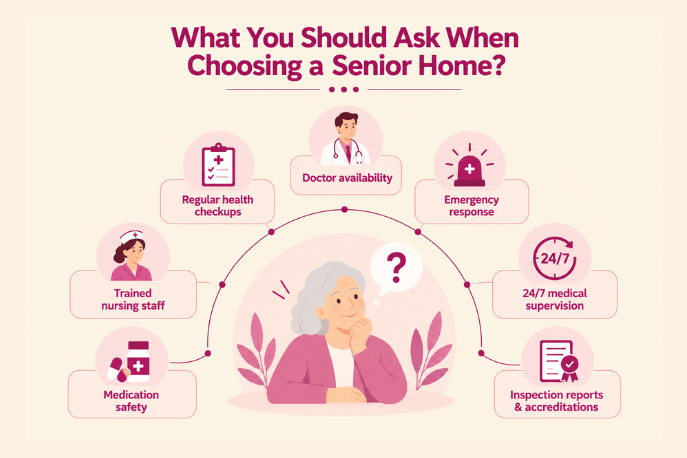
Questions families need to ask to ensure good medical oversight are:
- What is your procedure for doctor-on-call elder care? In other words, can you guarantee a physician would always be reachable?
- How often does the facility provide clinical care to seniors (labs, diagnostics, checkups)?
- What elderly nursing services in India do you provide? Are the nurses trained in geriatric care?
- How would you safely manage medications?
- What happens in emergencies?
- What additional costs will come if medical intervention is needed?
- Is there medical supervision 24 hours a day or just during particular hours?
- Shall I be allowed to view previous inspection reports or accreditations?
Challenges and Gaps in India’s Senior Care Medical Oversight
While institutionalized elderly care in India faces major challenges in medical oversight, much has been done for the care of the aged population in India. Deficiencies of these dimensions affect the quality, accessibility, and efficiency of services rendered to elderly citizens. Knowing these issues gives a family a basis on which to make suitable decisions and to advocate for better standards.
-
Lack of Trained Professionals
- Doctors: In India, there is an acute shortage of geriatric specialists. As of now, there exists only 1 geriatrician who caters to an aging population of 20,000 (Ministry of Health, 2024).
- Nurses and Caregivers: Many centers employ persons with little to no training. Types of medical supervision need registered nurses who are trained in areas of geriatrics, emergencies, and chronic disease.
- Implications: Due to insufficient staff, there is the likelihood of medication errors, delayed response to emergencies, and poor monitoring.
2. Limited Access in Rural and Semi-Urban Areas
- Urban-Rural Divide: Most of the high-quality facilities are concentrated in metro cities. About 65% of India’s elderly live in rural areas, where access to medical oversight is minimal.
- Traveling Troubles: Given the long distances to be traveled for hospital visits, such trips can prove physically exhausting for seniors and may even prove risky.
- Telemedicine Gap: Despite the availability of on-call doctors and checkups through telehealth, these services still have very limited reach in rural areas owing to poor internet penetration and infrastructure.
3 Affordability and Financial Barriers
- Expensive: Residential care, home nursing, or doctor-on-call elder care
services come with a hefty price tag. It differs according to the services, ₹25,000–₹1,20,000 in a month.
- Very few Insurances Allowed: Only 18 percent of senior citizens in India have medical insurance covering elderly care.
- Out-of-pocket Burden: Often, it is also the family that bears the entire financial burden, thereby delaying care or opting for informal, cheap services instead.
-
Disparate Standards and Regulation
- Quality Gaps: Many facilities operate without uniform standards, resulting in differential quality of medical supervision.
- No Accreditation: Only a few facilities are ISO certified or hold a recognized certificate of geriatric care.
- Insufficient Oversight: Audits and inspections carry an irregular nature at the government level, thus barely ensuring the enforcement of safety and medical protocols that are binding.
-
Awareness and Cultural Barriers
Many families remain unaware of the importance of a structured medical oversight in caregiving and just rely on basic caregiving.
Social stigma regarding residential care for those in need may keep families from seeking professional services when they are required.
Further gaps in knowledge about the treatment of chronic diseases, preventive medical screenings, and rehabilitation plague the delivery of care.
Tips for Families to Ensure Better Care for Loved Ones
To families, making sure that their elderly members are kept safe, cared for with respect, and medically supervised is paramount. The following are tips to assist families in evaluating and monitoring care:
-
Choose the Right Facility
- Check for Accreditation: Such a facility would ideally have ISO certifications or accreditation from some association in geriatric care.
- Medical Staff Availability: Make sure there are on-site doctors, nurses, and caregiving staff, round the clock.
- Services Provided: Doctor on-call elder care, clinical care for seniors, and rehabilitation ought to be an option.
Tip: Go to several facilities, ask for references, and talk to some residents or their family.
-
Verify Training of Staff and Group Size
- Staff-Resident Ratio: An adequate number of staff members to keep an eye on residents day and night.
- Training: A caregiver and nurse should be literally trained in geriatric care or medical fields.
- Emergency Preparedness: Falls prevention, CPR, and chronic disease management are to be on the list of staff training.
-
Monitor Medical Oversight
- Medical Records: Medical history, medications, and care plans should be maintained in duplicate copies.
- Updates: Try to have updates on health be forwarded to you either daily or weekly by the facility.
- Preventive Care: The elderly must be subjected to screening, vaccinations, and physiotherapy.
-
Engage Family & Care Team
- Communication: Keep caregivers and doctors in regular contact.
- Decision-making: In treatment and care plans, participate in treatment and care.
- Visits & Observation: Frequent visits are essential to observe one’s hygiene, nutrition, and psycho-affective conditions.
Conclusion: Prioritizing Your Loved One’s Health
Elderly loved ones must have medical supervision for proper health and well-being. By choosing an established provider, like Sahabhaav, you are assured that your loved ones will always be given high-standard care. Do not wait for a health crisis to put change in motion. Act now for a healthier tomorrow for your loved ones! Contact Sahabhaav today on 7777079797 or 9699696997 to learn more about our senior care services and how we can assist in providing the best care for your loved ones.
FAQs on Medical Oversight in Residential Senior Care
-
What does medical oversight in the senior care field mean?
Medical oversight is a period wherein skilled individuals supervise the seniors’ health, including personal monitoring, medication management, and provision for emergency care, all aimed at ensuring their safety.
-
Why would one need senior care medical supervision for the elderly?
It prevents health risks; manages health conditions; ensures acceptance for treatment; and elevates the safety and living quality of seniors.
-
How often is it necessary for the elderly to be under medical care?
Nurses and caregivers ought to be monitoring seniors daily, while visits and/or doctor check-ups should occur regularly at least monthly.
- What is included in clinical care for seniors?
Clinical care includes keeping notes of vital statistics, managing medication, physiotherapy, nutrition, preventive screening, and mental health support
A
A
Written and Reviewed by
Sahabhaav