
The elderly with dementia and amnesia suffer greatly from these long-term illnesses. They are forced to endure the agony of memory loss that makes them anxious, depressed, and exhibit changes in behaviour. They are confronted with numerous challenges that accompany this disease, including difficulty with words, and confusion and mobility issues towards the later stages. But then there are organizations such as Sahabhaav, which have devised individual care for senior individuals who are suffering from dementia or amnesia, and are committed to caring for them with extreme responsibility, love, and concern, and making them gain confidence in themselves. Knowing the disease will make you aware of the principal issues that accompany it.
Assisting your elderly parents, grandparents, or any other elderly members of your family who are afflicted with dementia or amnesia can be a big help to them. They may not tell you about their issues because they don’t want you to be burdened by it and feel ashamed about it. But the symptoms can be verified in advance with their activities or behaviors that you have to verify on a regular basis. It’s time to stand up for your elders like they stood up for you, and seek help if you are not capable of comprehending.
Sahabhaav is a geriatric care center where they assist your elder ones with proper, specialized medical attention and assistance for chronic diseases such as dementia and amnesia.
Dementia is the overarching term for a group of symptoms that impact one’s thinking, memory, and social behavior. You would witness the impact every day if you notice your older relatives, for example, forgetting appointments, being confused, being unable to manage money, or even forgetting loved ones. Alzheimer’s disease is one of the most frequent diseases that also has dementia. Other reasons are vascular dementia, i.e, due to decreased supply of blood to the brain, and Lewy body dementia due to abnormal clumps of proteins in brain cells.
These illnesses progressively kill brain cells and can cause confusion, memory loss, speaking difficulty, and mood or personality changes. Dementia becomes worse as time passes and worsens steadily. It will also affect everybody differently depending on what area of the brain is affected.
Here are Some Symptoms of Dementia
At Sahabhaav, we understand how difficult it can be to watch someone you love go through these changes. That’s why we offer thoughtful and compassionate care personalized to each individual’s needs, ensuring they feel safe, valued, and respected.
Amnesia means memory loss. It happens when a person forgets things because of reasons like a head injury, an illness, or a very stressful or traumatic experience. People with amnesia may forget past events or have trouble forming new memories, but other abilities like thinking clearly or solving problems usually stay the same.
Types of Amnesia
Causes of Amnesia
At Sahabhaav, we understand how confusing and emotional memory loss can be for both the person going through it and their loved ones. That’s why we’re here to offer support, patience, and gentle care every step of the way.
Alzheimer’s disease is a condition that slowly damages the brain over time. It causes brain cells to break down and die, which makes it harder for a person to remember things, think clearly, and make decisions. It’s the most common cause of dementia, responsible for about 60–80% of all dementia cases. People with Alzheimer’s often start by forgetting recent events or names, and over time, they may struggle with simple daily tasks, recognizing loved ones, or even speaking.
At Sahabhaav, we know how heartbreaking it can be to watch someone face these changes. That’s why our care is filled with love, patience, and respect, making sure each person feels seen, understood, and supported every day.
| Features | Dementia | Amnesia | Alzheimer’s Disease |
| Definition | Decline in cognitive function | Memory loss | Progressive brain disorder |
| Memory loss | Yes, along with other functions | Primary memory | Yes, especially recent memories |
| Other cognitive issues | Yes, including judgment and language | No significant cognitive decline | Yes, including judgment and language |
| Progression | Gradual | Variable | Gradual and irreversible |
| Common Causes | Alzheimer’s, vascular issues | Brain injury, psychological trauma | Unknown, genetic factors |
| Treatment | Symptom management | Depends on cause | No cure, symptom management |
The emotional trauma of dementia and amnesia is deep, not just for the individuals affected but also for their families and caregivers. Witnessing a loved one struggle with memory loss, confusion, and personality changes can be heart-wrenching. However, understanding these conditions can foster compassion and patience.
At Sahabhaav, we recognize the emotional challenges faced by those dealing with dementia and amnesia. Our team is dedicated to providing holistic care that addresses not only the physical but also the emotional and psychological needs of our patients and their families.
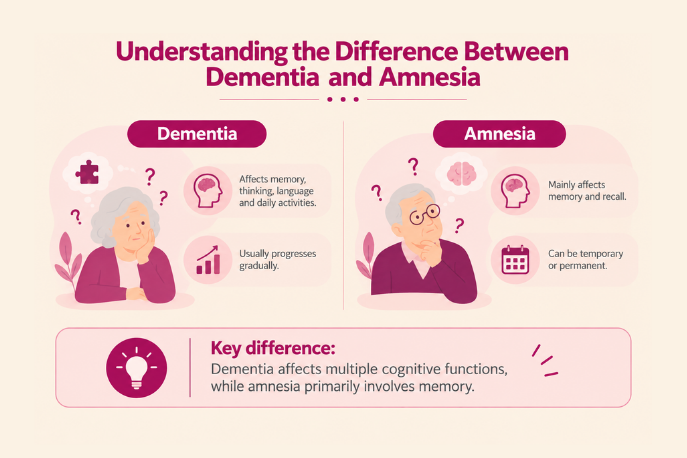
Dementia is a condition that affects not just memory, but also thinking, behavior, and the ability to carry out daily activities. In contrast, amnesia mainly involves memory loss without affecting other brain functions like decision-making or problem-solving. Dementia often develops slowly and worsens over time, while amnesia can happen suddenly due to an injury, illness, or emotional trauma, and in some cases, it can improve with the right care. People with dementia may forget familiar faces, struggle with time and place, and need help with everyday tasks. Those with amnesia may lose memories or have trouble creating new ones, but their overall thinking ability usually remains strong. Alzheimer’s disease, the most common cause of dementia, leads to a gradual decline in brain function. At Sahabhaav, we understand the emotional toll these conditions take on individuals and families. That’s why we provide gentle, respectful, and personalized care in a warm, home-like setting. Our goal is to support each person with love and dignity, helping them feel safe, valued, and never alone.
They offer-
Understanding the difference between dementia, amnesia, and Alzheimer’s disease is key to offering the right care and support. While dementia is a general term for a decline in memory and thinking abilities, Alzheimer’s disease is its most common cause, leading to progressive and permanent brain cell damage. Amnesia, on the other hand, refers to memory loss that can happen suddenly due to injury, illness, or trauma and doesn’t usually affect other cognitive functions.
Though different in nature, all three conditions deeply affect not just the individuals living with them, but also their families. The pain of seeing a loved one forget names, faces, or even their own identity is heartbreaking. It’s a slow kind of loss that brings sadness, confusion, and emotional exhaustion.
At Sahabhaav, we understand these struggles. We offer more than just care, we provide a safe, respectful, and loving environment where every elderly person is treated with compassion and dignity. Whether it’s dementia, amnesia, or Alzheimer’s, we focus on what remains, not just what’s lost. Our team supports both the elderly and their families through personalized attention, structured routines, and emotional care.
If you or a loved one is facing the challenges of dementia, amnesia, or Alzheimer’s disease, you don’t have to go through it alone. At Sahabhaav, we offer more than just a place to stay. Reach out today.
The treatment of amnesia depends on its cause. Some forms of amnesia are reversible if the symptoms are recognized earlier and the root problem is detected.
Alzheimer’s disease is the common cause of dementia, but not all dementia is due to Alzheimer’s.
There are medications to help with these diseases, but there is currently no cure for Alzheimer’s disease or many forms of dementia.
Alzheimer’s disease typically progresses through three broad stages. In the early stage, the person may experience mild memory lapses, confusion with familiar tasks, and difficulty finding words. In the middle stage, memory loss worsens, communication becomes more difficult, and assistance with daily activities is needed. In the late stage, the person requires full-time care, loses the ability to communicate verbally, and becomes physically dependent. Understanding these stages helps families plan care in advance. Sahabhaav’s dementia care programme in Mumbai is designed to support residents compassionately through every stage of cognitive decline.
Normal age-related memory loss involves occasional forgetfulness misplacing keys, forgetting names, or taking longer to recall information but does not interfere significantly with daily life. Dementia, by contrast, causes progressive memory loss that disrupts routine tasks, impairs judgement, affects language, and changes personality and behaviour. If you are noticing these more serious patterns, it is important to seek a professional geriatric assessment. Sahabhaav’s team can help determine whether what you are observing requires specialist care explore our dementia care services in Mumbai for more information.