

Let’s clear this up!!! Aren’t Alzheimer’s and dementia the same thing? If you also get confused between Alzheimer’s vs. dementia, then you are not alone. Many people use these terms interchangeably, but the difference between Alzheimer’s and dementia is very important to understand.
As dementia is a broader term, Alzheimer’s disease is a common type of dementia. This means Alzheimer’s is a form of dementia, but not all dementia is Alzheimer’s. Having some of the similar symptoms creates this confusion. Many families ignore them by considering them signs of aging.
Understanding the early signs of dementia vs. Alzheimer’s helps families to treat their loved ones timely, without further delay. In this blog, you will know the core difference in the simplest way along with their types, symptoms, stages and when to consult medical help.
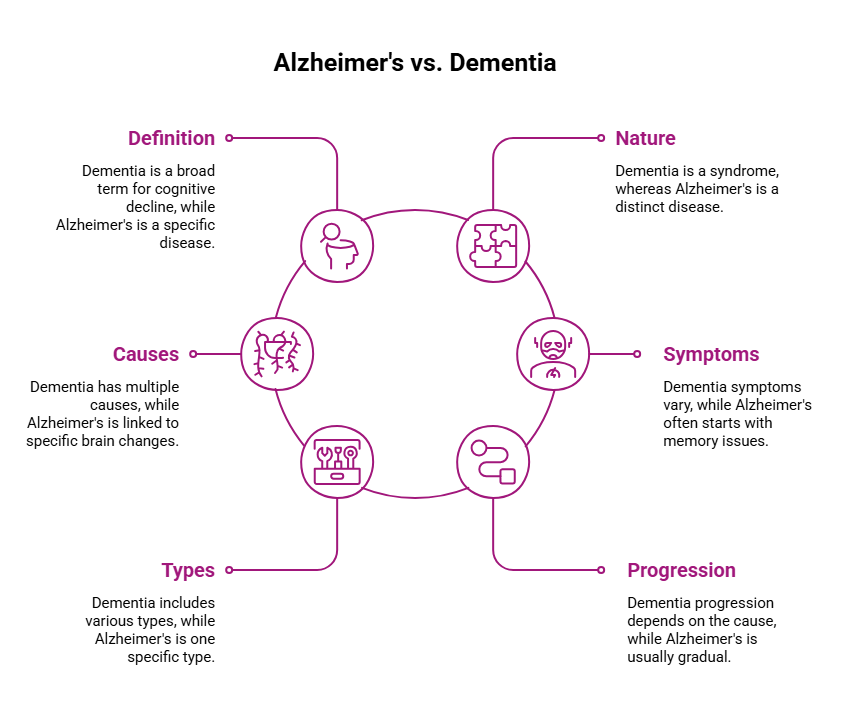
It is a general term used for a group of symptoms that affects memory, thinking, behaviour and daily activities. It is not a single disease but a condition caused by different brain disorders. People who suffer from dementia forget things often, feel confused, struggle with communication and face difficulty in performing daily activities.
According to the World Health Organization, around 50 million people have dementia worldwide, with one new case every 3 seconds. It is said that the number of people suffering from dementia will rise up to three times by 2050.
It is the most common type of dementia that slowly damages the brain cells over time. It mainly affects memory, learning, decision-making & behaviour and symptoms get worse with time. In early stages people may forget recent conversations or important information, but later it affects their ability to live independently.
According to the World Health Organization, nearly 60-70% of cases of dementia are suffering from Alzheimer’s disease globally, making it the most common cause of dementia in elderly people.
Although Alzheimer’s and dementia are closely connected, they are not at all the same. Understanding the difference between Alzheimer’s and dementia helps families to give the appropriate treatment to their loved ones. Here are 10 differences that make you clear these terms perfectly.
One of the biggest differences between these two is their causes. Dementia can develop due to several brain-related conditions, whereas Alzheimer’s has a more specific brain decay pattern.
Dementia Causes:
These are the reasons many people ask, “Can you have dementia without Alzheimer’s?” The answer to this question is YES.
Memory problems occur in both cases but happen differently. In Alzheimer’s disease, memory loss is the most common symptom, which gets noticed first. In dementia symptoms can vary depending on the causes as well as the type of dementia.
Alzheimer’s Disease:
Short-term memory loss appears in the early stages. People repeatedly ask the same questions, forget recent conversations or misplace the items frequently.
Dementia:
A person may first experience confusion, poor judgement and behaviour changes before the major memory loss symptoms are seen.
Their symptoms may look similar at first appearance, but they differ with time.
| Alzheimer’s | Dementia |
|
|
Understanding this Alzheimer’s vs. dementia symptoms comparison perfectly helps loved ones to detect early signs to have the chance of a cure.
Different types of dementia progress at different speeds, while Alzheimer’s disease develops slowly over several years.
Dementia:
Some forms, such as vascular dementia, worsen suddenly after a stroke or any brain injury.
Alzheimer’s:
Symptoms appear gradually and become more severe with time. It affects memory, communication and physical functioning step by step.
Many families compare Vascular Dementia vs. Alzheimer’s because both affect the cognitive abilities of the people but in different manners.
Vascular Dementia:
Alzheimer’s:
Both dementia and Alzheimer’s affect emotions as well as behaviour but the patterns of these changes are different from each other.
Dementia:
People become aggressive, anxious, suspicious or emotionally withdrawn depending on the dementia type.
Alzheimer’s:
People experience confusion, frustration, fear and emotional dependency as memory decline worsens with time.
Families caring for elderly parents find these emotional changes difficult to manage if not given proper support.
Many people thought, how do doctors diagnose Alzheimer’s vs. dementia, as there is no single test? Doctors combine several evaluations to diagnose them.
Dementia Diagnosis:
Alzheimer’s Diagnosis:
Doctors specifically look for memory-specific decline patterns as well as brain changes that are associated with Alzheimer’s disease.
With this early diagnosis, it can improve long-term care planning with treatment outcomes.
Communication problems appear in both conditions, but they develop differently depending on the area of the brain affected.
Dementia:
Some people struggle to find the right words, follow up with the conversation or understand instructions. As in certain dementia types, speech and language issues appear very early.
Alzheimer’s:
People began forgetting simple words, repeating the phrases while speaking or losing the track of conversations. As the condition worsens, communication becomes more difficult plus confusing.
The treatment approaches of these two vary because dementia can have multiple causes, while Alzheimer’s follows a specific disease progression.
Dementia Treatment:
Alzheimer’s Treatment:
This is the reason awareness around Alzheimer’s treatment options in India is increasing rapidly among caregivers.
These both are the conditions that affect the independence of the person in their own manner, but the caregiving journey differs for both of them.
Dementia:
Its impact depends upon the type along with the severity of the disease. Some individuals mainly struggle with behaviour, speech or mobility issues.
Alzheimer’s:
People need more support for their daily tasks like eating, bathing, remembering family members and personal safety as the disease progresses.
These long-term care needs have increased the conversations among families about dementia care for elderly parents in India. These conversations are mainly increased among those families to balance work, caregiving and emotional well-being.
While Alzheimer’s disease is the most common type of dementia, it is not the only one. There are several other types of dementia that have different causes as well as symptoms. Each type affects the brain differently. There are types of dementia, which help you in making your decision wisely.
Vascular dementia happens when the brain does not receive a healthy blood flow, which damages the brain cells over time. It occurs after strokes or conditions that affect blood circulation. It is considered the second most common type of dementia after Alzheimer’s disease.
Causes:
Symptoms:
It is a brain disorder caused by abnormal protein deposits called Lewy bodies that interfere with the normal brain functioning. It affects thinking, movement, sleep, mood and behavior simultaneously, which sometimes makes the diagnosis difficult.
It also shares certain symptoms with Parkinson’s disease that are related to body movement and muscle control.
Causes: Abnormal protein buildup in the brain cells and brain cell degeneration.
Symptoms: Visual hallucinations, sleep disturbances, muscle stiffness, tremors and fluctuating alertness & confusion.
In this, the front as well as the side part of the brain that controls personality, behaviour, emotions and language gets damaged. Compared to Alzheimer’s disease, it appears at a younger age, somewhere between 45 and 65 years of age.
Unlike Alzheimer’s disease, memory loss may not always be a noticeable symptom at first in frontotemporal dementia.
Causes:
Symptoms:
This disease develops in some people who have been living with Parkinson’s disease for several years. It occurs when brain cell damage begins to affect memory, thinking and reasoning abilities along with movement-related symptoms.
Unlike Alzheimer’s disease, physical symptoms such as tremors and muscle stiffness appear before cognitive decline becomes noticeable.
Causes: Brain cell degeneration linked to Parkinson’s disease
Symptoms: Slow thinking, memory problems, depression, hallucinations, difficulty focusing and difficulty in communication.
Mixed dementia occurs when a person experiences more than one type of dementia at the same time. Since multiple brain conditions are involved, symptoms can become more complex and harder to diagnose accurately. A person can experience both memory loss and physical coordination problems together.
Causes:
Symptoms:
| Dementia Signs | Alzheimer’s Signs |
| Confusion | Forgetting recent events |
| Mood changes | Repeating questions |
| Poor concentration | Misplacing items |
| Speech difficulties | Forgetting names |
| Balance problems | Getting lost easily |
| Poor judgment | Trouble with daily tasks |
| Social withdrawal | Forgetting dates and routines |
| Difficulty understanding | Increased dependency on reminders |
| Stage – 1 | At this stage, there are no visible symptoms of memory loss or confusion. The person functions normally in daily life while the cognitive changes are not yet noticeable even during the medical evaluations. |
| Stage – 2 | People occasionally forget names, misplace items or struggle to remember small details. These changes are mistaken for normal aging that does not interfere with daily activities. |
| Stage – 3 | Memory lapses become more noticeable to family members and close friends. The person may face trouble in concentrating, organizing tasks and remembering recent conversations and appointments. |
| Stage – 4 | At this stage, symptoms become clearer and begin affecting the daily life of the person. People struggle with managing finances, planning activities, remembering personal history and recent events. |
| Stage – 5 | Individuals need assistance with their daily tasks like choosing appropriate clothing or remembering personal information at this stage. Confusion about time, places and familiar environments also becomes common. |
| Stage – 6 | Memory loss becomes significant and personality or behavioral changes may appear. People may have difficulty in recognizing family members, communicating clearly or performing basic daily activities independently. |
| Stage – 7 | This is the final stage of dementia, where individuals may lose the ability to speak, respond or control physical movements. Full-time care & support is required to manage daily needs as well as safety. |
Choosing the right dementia care center for your loved ones is a very tough decision for family members. This can be simplified by asking the right questions that help in ensuring all the necessary details that they need for their loved ones.
Pro Tip: It is important for families to observe how caregivers interact with residents during visits. It is crucial to provide compassionate and emotional support along with medical care for dementia.
At Sahabhaav, families dealing with Alzheimer’s and dementia find it a blend of care, comfort and medical support. Our focus is on making seniors feel safe and emotionally supported in a homely environment. Trained caregivers help with daily needs like routine care as well as supervision.
They also engage seniors in small activities to keep them calm and involved. With dedicated dementia care services in Mumbai, we provide proper attention with structured care.
Families are regularly updated, which helps in reducing their worry and stress. By providing healthcare expertise with empathy-driven support, we create a supportive environment that makes them feel relieved and happy.
Families Feedback 1. A family shares their experience about caring for a loved one with dementia and how structured support helped improve daily care and emotional stability. Watch Now: https://www.youtube.com/watch?v=rw8-g7v_RCA 2. This story highlights how professional caregiving support reduced stress for working family members and improved senior safety. Watch Now: https://www.youtube.com/watch?v=tJtl7Hbm3g8 |
Finally,
Understanding Alzheimer’s disease vs. dementia helps families to recognize symptoms early so that they can take necessary steps, whatever they are. As both the conditions affect memory as well as thinking; they are different in causes, progression and treatment approaches.
Sahabhaav helps families with personalized elderly care, emotional support and safe dementia care that help families to ensure comfort & safety for seniors.
Most types of dementia, including Alzheimer’s disease, cannot be completely cured or reversed. With early treatment, proper care and lifestyle support help in managing symptoms in some individuals.
Alzheimer’s is a type of dementia, not a separate condition. Some people experience more severe symptoms with Alzheimer’s, while other types of dementia can also become serious over time.
Dementia is highly common in 2026, as around 55 million people are affected worldwide. This is growing rapidly with time as lifestyle changes are occurring more frequently.